
Published · 7 min read · Facts checked 9 October 2026 against the sources below
There are more things to do in Cyprus than most people fit into one holiday: Roman mosaics, painted mountain churches, a divided capital, salt-lake flamingos and calm, clear bays. A toll-free motorway network links the main towns, so you can see a lot of it from one base on the west coast near Coral Bay, Paphos.
What you can't do is see all of it easily. Some of the best places to visit in Cyprus are close to Paphos, and some are on the far side of the island. What follows goes region by region, west to east, and the table at the end sorts the easy trips from the long ones. Opening hours and prices change, so check before you set off.
Paphos and the Akamas
This is the corner of Cyprus you will know best if you stay with us, and it has enough for a week on its own. Our guide to the sights of Paphos town covers it in detail, so here are the headlines.
The Archaeological Park of Kato Pafos has been on the UNESCO World Heritage list since 1980. Its floor mosaics, in the Houses of Dionysos, Theseus, Aion and Orpheus, are the reason most people come, and the same ticket takes in the Odeon, the Agora and Saranta Kolones. The Tombs of the Kings have their own ticket. Entry to the park is €4.50 at the time of writing.
East along the coast is Petra tou Romiou, the rock where Aphrodite is said to have risen from the sea foam. North of Paphos the land turns wild. The protected turtle beaches at Lara and the boat trips to the Blue Lagoon from Latchi are the two Akamas outings everyone asks about. Closer still are the Sea Caves at Peyia and Coral Bay beach.
The Troodos and the painted churches
The Troodos range fills the middle of the island, a world away from the beaches in feel.
The thing to see is the Byzantine Route. Ten small churches in the Pitsilia, Solea and Marathasa areas are on the UNESCO World Heritage list together. From outside they are modest buildings under steep-pitched timber roofs; inside, the walls are painted. Panagia Asinou, Agios Nikolaos tis Stegis, Agios Ioannis Lambadistis and Panagia tou Araka are among them.
You won't see all ten in a day, and you shouldn't try. Pick two or three in one valley. Our guide to the Troodos from Paphos has the routes, the walks and what to expect from the mountain roads.
Limassol, Kourion and Pissouri
The A6 motorway runs 66 km from Paphos to Limassol, and the best stops are on the way rather than in the city.
Kourion lies 19 km west of Limassol, on the Paphos road. Its Greco-Roman theatre was built in the 2nd century BC and enlarged in the 2nd century AD, and it still hosts performances in summer. The mosaics in the House of Eustolios are worth the walk. Entry is €4.50 at the time of writing. Our Kourion guide explains how to plan a visit.
Kolossi Castle, 14 km west of Limassol, was built in the 13th century, rebuilt in the 15th and belonged to the Knights of St John. Entry is €2.50 at the time of writing. Pissouri, on the same stretch, makes a good swim stop: see our Pissouri guide.
For Limassol itself, how to get there and what to combine it with, read our guide to Limassol and Larnaca from Paphos.
Nicosia, the divided capital
Nicosia (Lefkosia) is the most unusual city on the island, and it is inland, so you reach it on the A1 after the A6. The old town sits inside Venetian walls built in the 16th century, with 11 heart-shaped bastions. The moat around them, 80 metres wide, is now gardens, sports grounds and car parks.
The city is divided, and you can walk across to the north. The Ledra Street (Lokmaci) and Ledra Palace crossings are for pedestrians only. Our Nicosia day trip guide covers the walk across, the museums and how to plan the day.
Larnaca and the south-east
Larnaca is the island's other airport town, and it is easy to underrate. The church of Agios Lazaros, built in the 9th century by Emperor Leo VI, holds what is believed to be the tomb of Lazarus beneath its sanctuary, and its iconostasis is covered in gold. Entry is free.
On the edge of town, the Larnaca Salt Lake is a protected wetland where flamingos gather from November to March, with a 4 km nature trail and Hala Sultan Tekke nearby. Offshore lies the Zenobia, a Swedish ferry that sank on its maiden voyage in 1980. It is 172 m long and lies at 18 to 42 m, and you need Advanced Open Water level to dive it.
On the way there from the west, Choirokoitia sits beside the Nicosia to Limassol motorway. It is a Neolithic village on the UNESCO list since 1998, with five of its houses reconstructed. Entry is €2.50 at the time of writing.
Ayia Napa, Cape Greco and Protaras
The far south-east corner is the other end of the island from Paphos. You go via Limassol and Larnaca, and then the A3 runs 55 km from Larnaca Airport to Ayia Napa.
It is worth it if you love beaches. Nissi Beach near Ayia Napa has fine golden sand and shallow, calm water, and a reputation for music and beach parties. Fig Tree Bay at Protaras takes its name from a single fig tree said to have stood there since the 17th century, and Konnos Bay is a small sheltered cove with a path up into the forest park. Our guide to the best beaches in Cyprus compares them with the beaches on the Paphos side.
Between Ayia Napa and Protaras, the Cape Greco (Cape Gkreko) National Forest Park covers 385 hectares of limestone cliffs, sea caves, pine and juniper. A 4 km linear trail of about an hour and a half passes the Kamara tou Koraka rock arch and ends at the little church of Agioi Anargyroi, with steps down to a sea cave.
Things to do in Cyprus from a Paphos base
Here is how the regions compare from the Paphos side. The table gives motorway lengths rather than drive times, because traffic and stops change everything. Our guide to driving in Cyprus covers the roads themselves.
| Region | How you get there from Paphos | Our verdict |
|---|---|---|
| Paphos town and the Akamas | Local roads | Easy: half days, many times over |
| Kourion, Kolossi and Pissouri | The A6 (66 km Paphos to Limassol) | An easy day, with time for a swim |
| The Troodos and its churches | Mountain roads, winding and slower | A full day; pick one valley |
| Limassol | The A6 | A comfortable day |
| Nicosia | The A6, then the A1 (73 km) | A full day; leave early |
| Larnaca and Choirokoitia | The A6, then the A1 and A5 east | A full day |
| Ayia Napa, Cape Greco, Protaras | The A6, A1, A5, then the A3 (55 km) | Long: better with a night away |
The pattern is simple. The west and the mountains are day trips. Nicosia and Larnaca are big days. The south-east is a long way to go and come back in one go, so if Cape Greco is on your Cyprus bucket list, think about a night there, or a slow start the day after.
For a week's holiday, a pattern that works well is two or three days around Paphos and the Akamas, one day east along the coast to Kourion and Pissouri, one day in the mountains, and one big day out to Nicosia or Larnaca. That leaves a day or two at the pool, which after a few early starts you will want. Mixing short outings with long ones keeps everyone happier than a run of big days in a row, especially with children or in the heat of July and August.
Where to stay
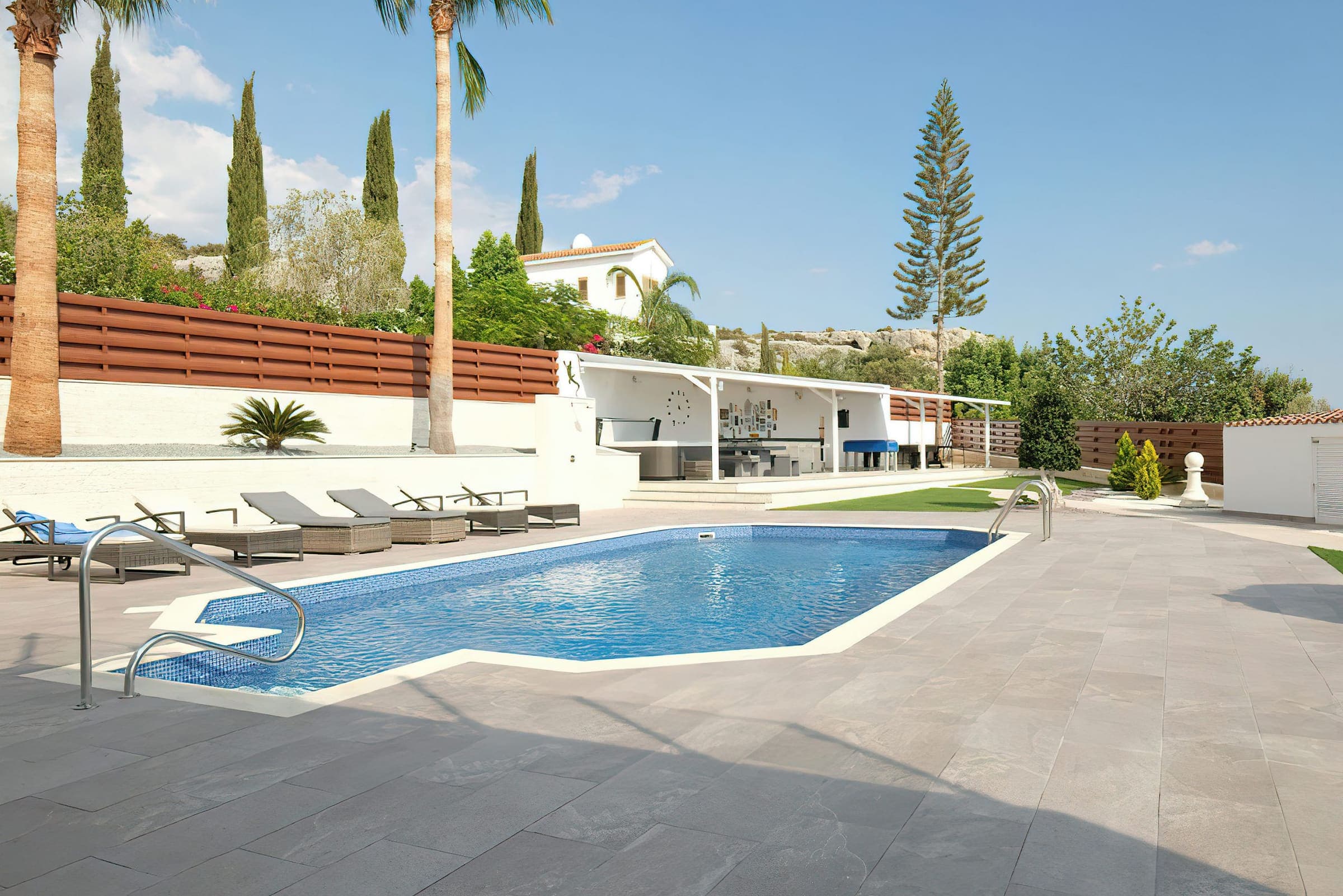
Villa Prasino is a private villa in Peyia for up to 6 guests, about 2 km from the Sea Caves, 5 km from Coral Bay beach and 5 km from the Akamas National Park. After a long day on the road, come back to a 6 × 12 m diving pool, a hot tub and an outdoor bar with a fire pit, in 1,000 m² of gardens. See our villa with a private pool, check availability and rates, or send us a booking request.