

Skip to content
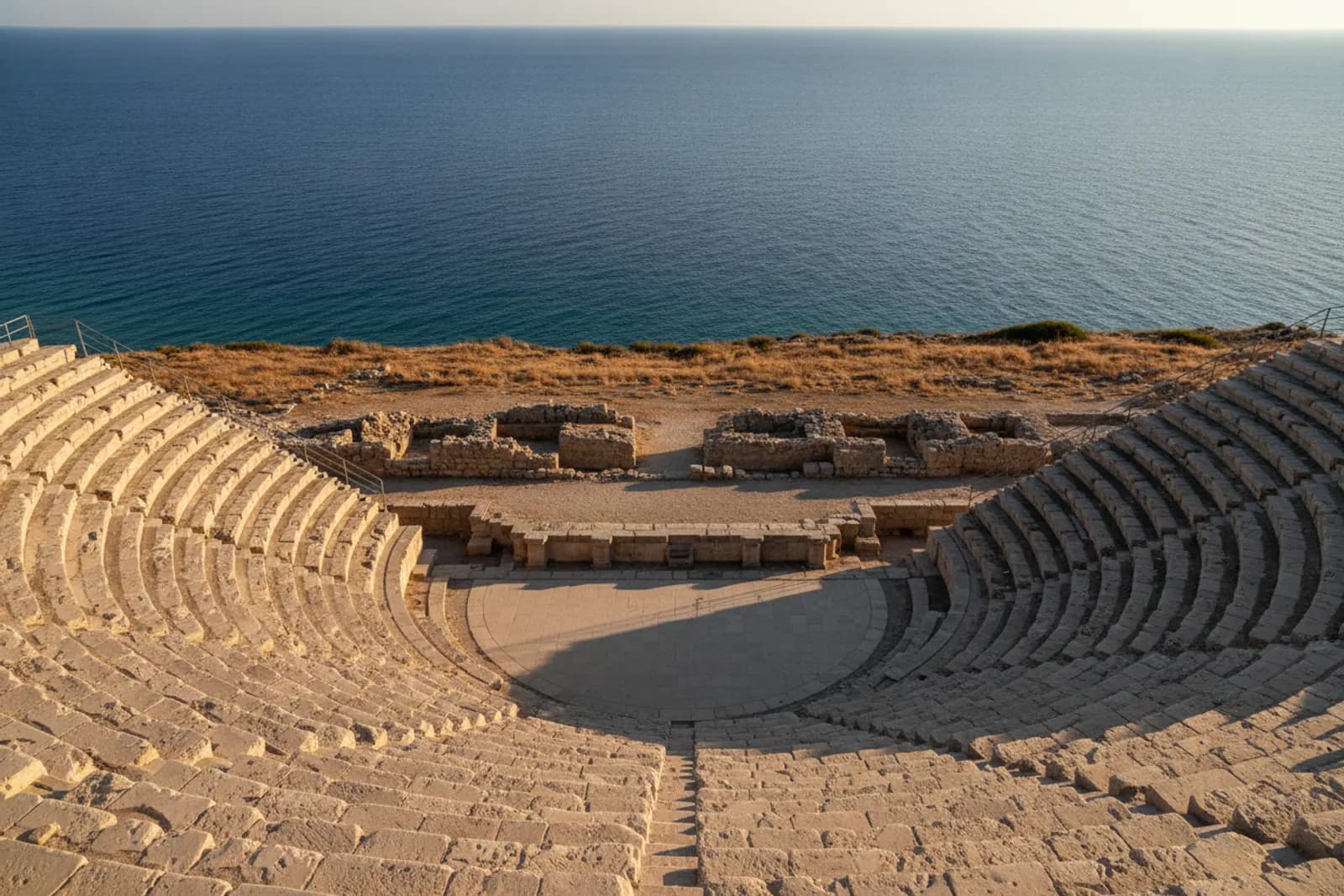
The ancient theatre at Kourion, its horseshoe of limestone tiers open to the sea on a clifftop above Episkopi Bay

Ancient Kourion, on the cliffs above the sea

A Greco-Roman city-kingdom on a cliff top west of Limassol, with a theatre that still fills on summer nights. Here is what to see, when to go and how to make a day of it from the Paphos side.

AI-generated illustration

Published · 7 min read · Facts checked 9 October 2026 against the sources below

Kourion is the great ancient site of the south coast of Cyprus. It sits on a cliff top above Episkopi Bay, 19 km west of Limassol, with a Greco-Roman theatre facing the sea, floors of late Roman mosaics and a beach right below. From Coral Bay, Paphos, it is a drive east along the coast, and it makes one of the best days out from the west of the island.

Our Paphos to Limassol and Larnaca guide gives Kourion a short stop on the way to Limassol. It deserves longer: there is enough here for a full day, with the beach below and the Sanctuary of Apollo Hylates a short drive west.

What Kourion was

Kourion was one of the city-kingdoms of ancient Cyprus. Tradition links it to settlers from Argos in Greece, who are said to have arrived in the 12th century BC. The city's acropolis stands on a limestone promontory nearly 100 metres above the sea, which is why the views are as much a reason to come as the stones.

A series of strong earthquakes struck between 365 and 370 AD, and a severe one in 365 destroyed the city. Kourion was rebuilt, and much of what you see dates from the centuries either side of that disaster.

One unusual detail: the site lies inside the British Sovereign Base Area of Akrotiri, though the Cyprus Department of Antiquities runs it.

The theatre, or Kourion amphitheatre

Most people call it the Kourion amphitheatre, but strictly it is a theatre: a half-circle of seats facing a stage, not a closed oval arena. It was first built at the end of the 2nd century BC and reached its present size in the 2nd century AD. In the early 3rd century it was turned into an arena for animal fights, before going back to plays later that century. It could hold up to 3,500 people.

The University of Pennsylvania began excavating here in 1933, and the theatre has since been restored. From the top rows you look down over the stage to the sea.

Summer performances

The theatre is still in use. It hosts concerts and plays, especially in summer. In summer 2026, for example:

  • Shakespeare at Curium, a charity production in English that has run since 1962, staged Othello on 9 to 11 July at 8pm.
  • The International Festival of Ancient Greek Drama, in its 29th year, used the theatre for ancient tragedy and comedy. It is organised by the Deputy Ministry of Culture and the Cyprus Centre of the International Theatre Institute.
  • Concerts of Greek music, such as a Mikis Theodorakis evening on 25 July at 9pm.

Programmes change every year: the 2026 drama festival programme was announced in June, and its tickets were sold through SoldOut Ticket Box. Bring a cushion, because the seats are stone, and a layer for after dark.

The mosaics

Kourion's grand houses kept some of the finest floor mosaics on the island. Three are the highlights.

The House of Eustolios was built as a private house in the early 5th century AD and later opened to the public once its baths were added. An inscription at the entrance welcomes visitors and names Eustolios as the builder, and another says the house is protected by the signs of Christ, so its owner was a Christian. The central room has four panels of 5th-century mosaics, and the baths include a mosaic of Ktisis, a woman personifying Creation, holding an architect's ruler. You can still see the cold, warm and hot rooms of the bath complex, with the heating channels under the floors.

The House of the Gladiators dates from the second half of the 3rd century AD. Its mosaics near the main courtyard show gladiators fighting.

The House of Achilles, from the 4th century AD, is named after its mosaic of the Greek hero. It was probably a building for receiving official guests.

PlaceDateWhat to look for
Theatre2nd century BC to ADSea views from the top rows
House of EustoliosEarly 5th century ADMosaic inscriptions, Ktisis, the baths
House of the GladiatorsLate 3rd century ADGladiator combat scenes
House of Achilles4th century ADThe mosaic of Achilles
Agora and NymphaeumEarly 3rd century ADMarble columns, the public fountain house
Early Christian basilica5th century ADThe separate baptistery
Stadium2nd century ADThe only ancient stadium found in Cyprus
Sanctuary of Apollo Hylates8th century BC onwardsThe partly rebuilt temple

The agora, the basilica and the stadium

Beyond the houses, the city centre spreads along the cliff top. The Roman agora dates from the early 3rd century AD and has porticoes with marble columns, a public bath and a Nymphaeum, a monumental fountain house.

Nearby stands the Early Christian basilica, built in the 5th century AD and probably the city's cathedral. It had three aisles and a separate baptistery.

The stadium is about 1 km west of the main site. It dates from the 2nd century AD, held around 6,000 spectators and staged the events of the pentathlon. It is the only ancient stadium found in Cyprus, and entry is free.

The Sanctuary of Apollo Hylates

About 3 km west of the main site is the Sanctuary of Apollo Hylates, the "Apollo of the woodland", who was Kourion's protector. It ranked among the most important sanctuaries on the island. Worship went on here from the 8th century BC to the 4th century AD, and most of what stands today comes from 1st-century AD restorations.

You walk through pilgrims' halls, a palaistra where athletes trained, a bath complex and the sacred precinct, up to Apollo's temple, which has been partly rebuilt. It is quieter than the main site, and in summer it is a good last stop before the drive home.

Opening hours, fees and the heat

In 2026 the Kourion site and the Sanctuary of Apollo Hylates both open daily at 08:30. They close at 19:30 from 16 April to 15 September and at 17:00 the rest of the year. Both close on Christmas Day, New Year's Day and Orthodox Easter Sunday.

SiteEntry
Kourion archaeological site€4.50
Sanctuary of Apollo Hylates€2.50
StadiumFree
Department of Antiquities pass€8.50 (1 day), €17 (3 days), €25 (7 days)

The pass covers any of the Department's sites and museums, each once, and pays off if you plan to see several of them in a few days. The main site is only partly accessible for wheelchairs. Prices and hours change without notice, so check before you go.

The small Kourion museum in Episkopi village, which shows skeletons of people killed in the 4th-century earthquakes, has been closed for upgrade works since 1 August 2026, with no reopening date announced as of October 2026.

Kourion beach

Below the cliffs lies Kourion beach, a 1 km stretch of sand and pebbles in Episkopi Bay with a wide shore and clear water. It held a Blue Flag in 2026. Lifeguards are on duty from April to October, and there are toilets, showers, changing rooms, sunbeds and umbrellas, fish taverns and disabled access. Windsurfing is possible here too.

After a hot morning on the ruins, an afternoon here is the obvious reward. For calm swims closer to home, see our best beaches near Coral Bay.

A day at Kourion from the Paphos side

The motorway is quicker, but the old Paphos to Limassol road is the better drive one way. Heading east from Paphos it passes Petra tou Romiou, then the village of Pissouri, then the Sanctuary of Apollo Hylates and Kourion. A plan for a summer day:

  1. Leave early and take the motorway for speed, so you reach Kourion at opening time.
  2. See the theatre, the House of Eustolios and the basilica while it is cool.
  3. Drive the short way west to the stadium and the Sanctuary of Apollo Hylates.
  4. Lunch and a swim at Kourion beach.
  5. Come home on the old coast road, stopping at Pissouri and at Aphrodite's Rock for the late light.

Our Pissouri guide covers the bay and the white cliffs on the way, and our driving in Cyprus guide has the road rules. In spring and autumn you can take it more slowly and do the ruins in the afternoon.

Where to stay
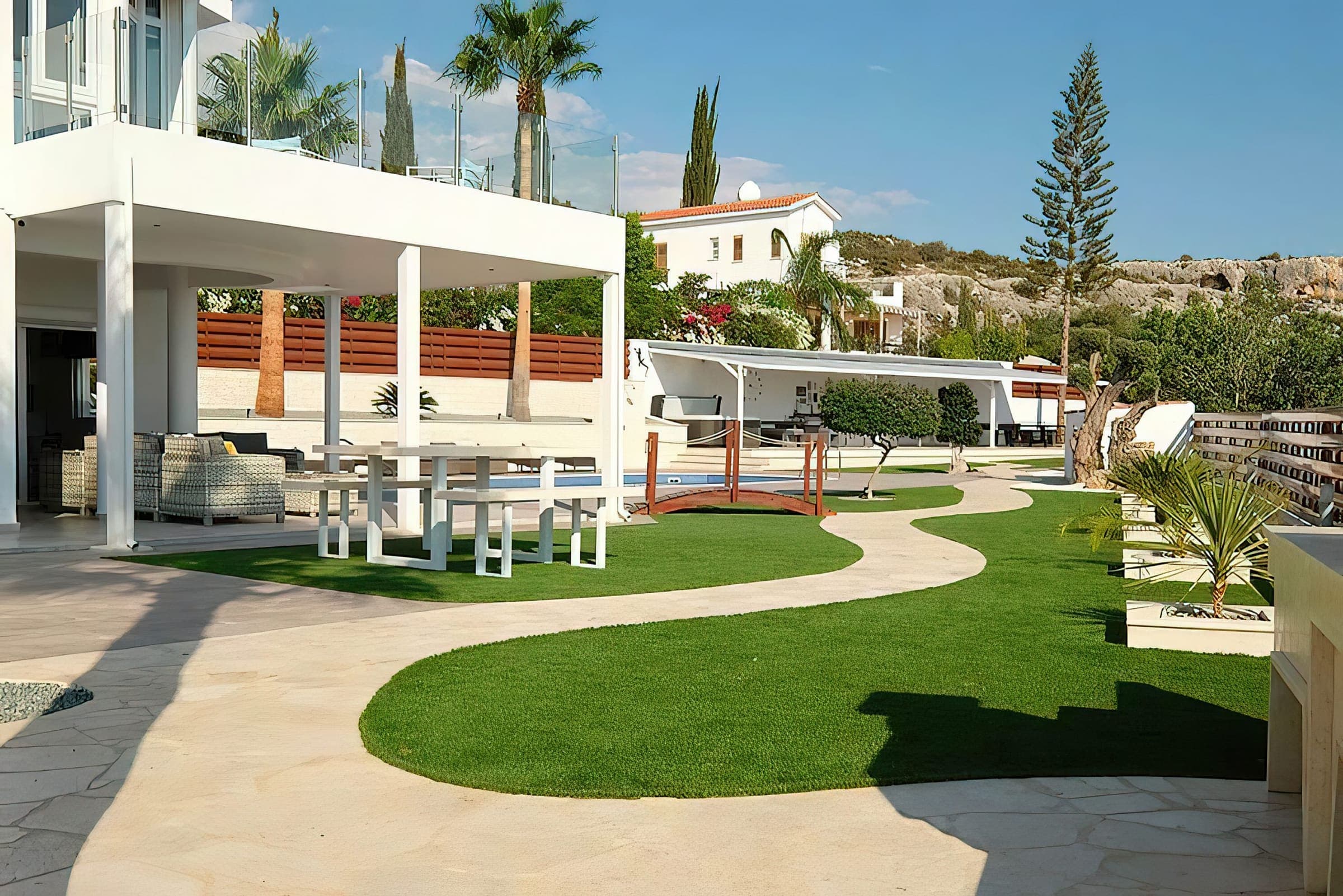
Covered terrace with outdoor dining overlooking the garden
The covered terrace and outdoor dining, overlooking the garden.

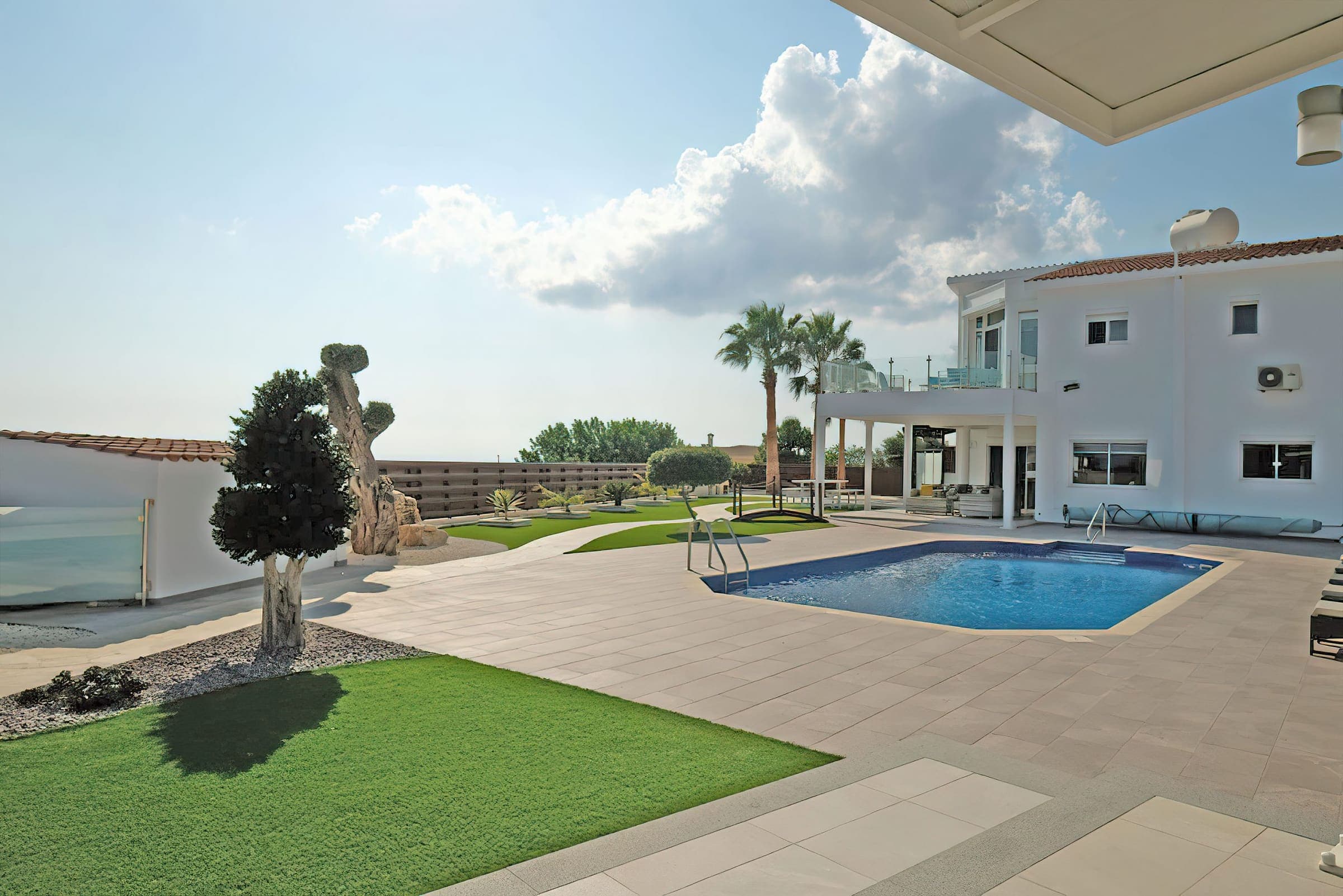
Villa Prasino is a private villa in Peyia, above Coral Bay on the Paphos coast, for up to 6 guests in 3 bedrooms. After a long day on a hot hillside there is a 6 × 12 m diving pool, a hot tub, covered outdoor dining and a traditional stone BBQ, in 1,000 m² of gardens with sea and mountain views. The Sea Caves are about 2 km away and Coral Bay beach about 5 km. See our villa with a private pool, check availability and rates, and send us a booking request when you are ready.
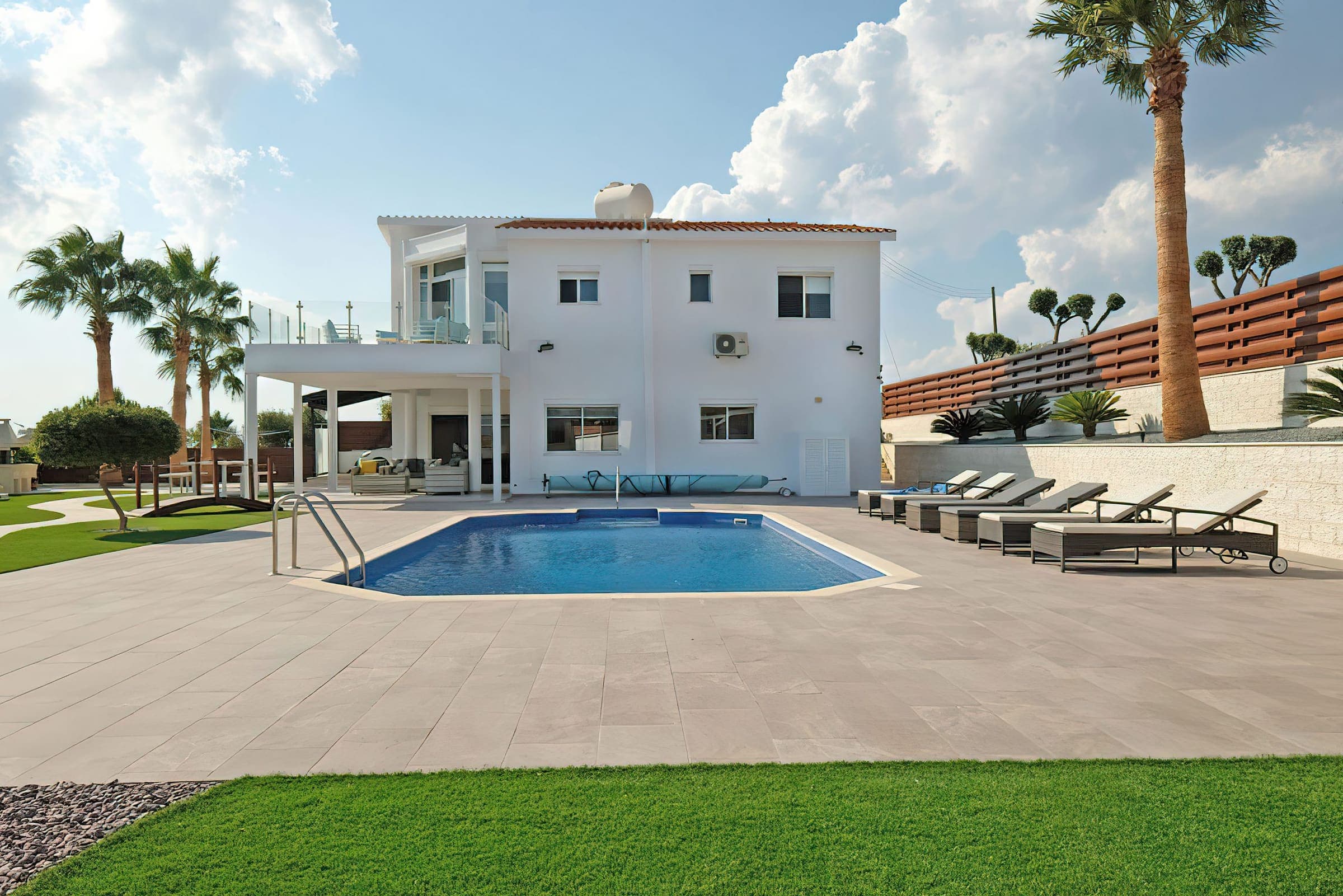
The white two-storey villa behind the pool and sun loungers

Where to stay

Villa Prasino, Peyia

Villa Prasino is a beautifully landscaped, 1,000 m² private holiday hideaway, just a short drive from Coral Bay. Set between the sea caves of Peyia and the unspoilt Akamas Peninsula, it’s the perfect base for your holiday in Paphos, Cyprus.

Sleeps 6 · 3 bedrooms · 3.5 bathrooms · 6 × 12 m diving pool · hot tub

Questions

Good to know

Where is Kourion?

Kourion is on a cliff top above Episkopi Bay on the south coast of Cyprus, 19 km west of Limassol on the road to Paphos.

What are the opening hours of Kourion?

In 2026 it opens daily at 08:30, closing at 19:30 from 16 April to 15 September and at 17:00 the rest of the year. It closes on Christmas Day, New Year's Day and Orthodox Easter Sunday. Check before you go.

Are there performances at the Kourion amphitheatre?

Yes. The restored theatre hosts plays and concerts, mainly in summer, including Shakespeare at Curium and the International Festival of Ancient Greek Drama. Dates change every year.

Is Kourion beach good for swimming?

It is a Blue Flag beach of sand and pebbles with lifeguards from April to October, toilets, showers and sunbeds. Windsurfing is possible there too.

How far is the Sanctuary of Apollo Hylates from Kourion?

About 3 km west of the main Kourion site, on the road towards Paphos. It has its own ticket and the same opening hours.

Sources

How we checked this guide

The facts about the area come from these sources, checked on 9 October 2026. Opening times, prices and timetables change, so check with the operator before you set off. Distances from the villa and our hire prices come from us.

  1. 01

    Visit Cyprus (Deputy Ministry of Tourism)

    Kourion Archaeological Site (opens in a new tab)

    Kourion 19 km west of Limassol towards Paphos; an important city-kingdom destroyed by an earthquake in 365 AD; the theatre (2nd century BC, extended 2nd century AD); the House of Eustolios with 5th-century mosaics and its bath complex; the Houses of Achilles and the Gladiators; the early 3rd-century Roman agora, public bath and Nymphaeum; the 5th-century Early Christian basilica with a separate baptistery; the stadium 1 km west; opening hours, €4.50 entry, closing days, partly accessible.

    Checked 9 October 2026

  2. 02

    Visit Cyprus (Deputy Ministry of Tourism)

    Theatre of Kourion (opens in a new tab)

    Built at the end of the 2nd century BC and given its present size in the 2nd century AD; an arena for animal fights in the early 3rd century, then a theatre again; up to 3,500 spectators; excavations from 1933 by the University of Pennsylvania; cultural events and performances, especially in summer.

    Checked 9 October 2026

  3. 03

    Visit Cyprus (Deputy Ministry of Tourism)

    Kourion Mosaics (opens in a new tab)

    The House of Eustolios (early 5th century, a welcoming inscription, later opened to the public), the House of the Gladiators (late 3rd century, gladiatorial combats) and the House of Achilles (4th century, the hero's mosaic, probably a reception building for official guests).

    Checked 9 October 2026

  4. 04

    Visit Cyprus (Deputy Ministry of Tourism)

    Kourion Stadium (opens in a new tab)

    The only ancient stadium found in Cyprus; 2nd century; 6,000 spectators; pentathlon events; free admission; an audio guide for the Kourion site.

    Checked 9 October 2026

  5. 05

    Visit Cyprus (Deputy Ministry of Tourism)

    Sanctuary of Apollon Hylates (opens in a new tab)

    3 km west of the Kourion site and 22 km west of Limassol; Apollo Hylates, god of the woodland and protector of Kourion; worship from the 8th century BC to the 4th century AD; most remains from 1st-century AD restorations: the partly restored temple, pilgrim halls, palaistra, baths and holy precinct; opening hours, €2.50 entry, closing days.

    Checked 9 October 2026

  6. 06

    Visit Cyprus (Deputy Ministry of Tourism)

    Kourion Beach – Blue Flag (opens in a new tab)

    In Episkopi Bay, 1 km long, sand and pebbles with a wide shore; lifeguards from April to October; toilets, showers, changing rooms, sunbeds, umbrellas and fish taverns; windsurfing; disabled access; parking.

    Checked 9 October 2026

  7. 07

    Sigmalive

    56 beaches and two marinas in Cyprus receive Blue Flags for 2026 (12 June 2026) (opens in a new tab)

    Kourion and Pissouri are among the Limassol district's Blue Flag awards for 2026.

    Checked 9 October 2026

  8. 08

    Visit Cyprus (Deputy Ministry of Tourism)

    Local Archaeological Kourion Museum, Episkopi (opens in a new tab)

    The museum in Episkopi village, in George McFadden's former house; skeletons of people killed in the 4th-century earthquakes, found in a Roman house; closed to visitors from 1 August 2026 for upgrade works, reopening date to be announced.

    Checked 9 October 2026

  9. 09

    Wikipedia

    Kourion (opens in a new tab)

    The acropolis on a limestone promontory nearly 100 m high above Episkopi Bay; the site lies in the British Sovereign Base Area and is managed by the Department of Antiquities; settlers from Argos in the 12th century BC; a run of strong earthquakes from 365 to 370; the three-aisled basilica, the city's cathedral; the Eustolios inscription about the signs of Christ and the Ktisis mosaic; the stadium about 187 m long; Apollo Hylates as the island's third most important sanctuary.

    Checked 9 October 2026

  10. 10

    Department of Antiquities, Cyprus

    Ancient monuments and museums: opening hours and fees (opens in a new tab)

    Special entry cards for the Department's sites valid for one, three or seven days, at €8.50, €17 and €25, each site once per card.

    Checked 9 October 2026

  11. 11

    Cyprus Mail

    What's on this weekend (9 July 2026) (opens in a new tab)

    Shakespeare's Othello at the Curium Ancient Theatre on 9–11 July 2026 at 8pm, in English, a charity production; Shakespeare at Curium has run since 1962.

    Checked 9 October 2026

  12. 12

    Limassol Tourism Development and Promotion Company

    Mikis Theodorakis: a night without end (opens in a new tab)

    A concert at the Ancient Theatre of Kourion on 25 July 2026 at 9pm.

    Checked 9 October 2026

  13. 13

    Cyprus Mail

    Get ready for 2026 International Festival of Ancient Greek Drama (20 November 2025) (opens in a new tab)

    The festival's 29th edition in summer 2026, run by the Deputy Ministry of Culture and the Cyprus Centre of the International Theatre Institute, with ancient tragedy and comedy.

    Checked 9 October 2026

  14. 14

    International Theatre Institute

    International Festival of Ancient Greek Drama 2026: programme announcement (opens in a new tab)

    The festival's performances at the Curium Ancient Theatre; tickets through SoldOut Ticket Box.

    Checked 9 October 2026

  15. 15

    Visit Cyprus (Deputy Ministry of Tourism)

    Main 9: Kofinou – Lemesos (Limassol) – Pafos (Paphos) cycling route (opens in a new tab)

    The old Paphos–Limassol road passes, from the Paphos end, Petra tou Romiou, Pissouri, Avdimou, Paramali, the Episkopi base, the Sanctuary of Apollo Hylates, Kourion and Episkopi.

    Checked 9 October 2026

  16. 16

    World Meteorological Organization, via NOAA NCEI

    WMO Climate Normals 1991–2020: Pafos Airport (17600) (opens in a new tab)

    Average daily highs at Paphos Airport in July and August.

    Checked 9 October 2026

Get the next guide

A few emails a year: new guides like this one, quiet weeks and offers from the villa.

A few emails a year about dates, offers and the villa. No sharing with anyone else, and you can leave from any email. How we use your details.

Villa exterior with pool, lawn and a mature olive tree

Availability

Plan your stay

Tell us your dates and who’s coming — we’ll reply personally with availability and a quote.

Next available arrival

Saturday 17 October 2026

Saturday & Wednesday arrivals · A week or more, 3 nights in winter · Nightly rates on request

Booking direct, step by step

  1. 1Choose your dates and tell us who’s coming
  2. 2Choose your upgrades and any extras you’d like
  3. 3Send your request — no payment needed yet
  4. 4We confirm and send your quote and secure payment details

We’ll confirm availability and send your personal quote within 24 hours.