
Published · 6 min read · Facts checked 9 October 2026 against the sources below
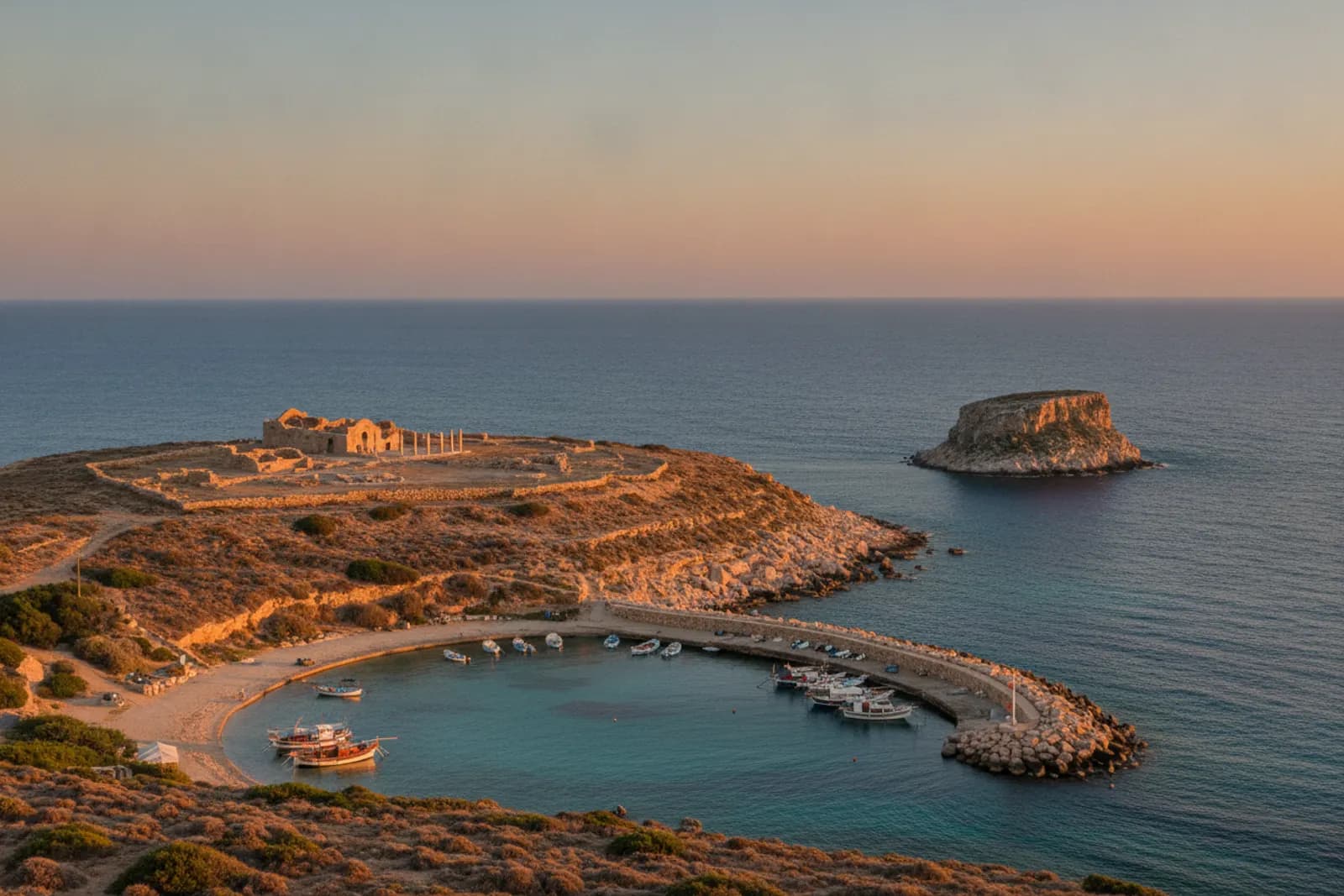
Agios Georgios Pegeia is the place north of Peyia where a quiet stretch of coast meets a very long history. On Cape Drepano, a headland on the west coast near Coral Bay, Paphos, a small fishing harbour sits below the ruins of a 6th-century town, a chapel that draws pilgrims from across the district, and cliffs cut with ancient tombs. Just offshore is Yeronisos, the "holy island", where archaeologists from New York University have dug for more than 25 years. Opening hours and prices change, so check before you set off.
Where Agios Georgios Pegeia is
The archaeological site is about 4.5 km from Peyia village, and Cape Drepano is about 15 km from Nea Paphos. The headland is covered in scrub of lentisk, carob and prickly pear, and it looks out west over the open sea.
It sits on the same stretch of coast as the Sea Caves, which are about 2 km from our villa, and the wreck of the Edro III. Our guide to the Edro III shipwreck covers that part of the shore, so here we stay on the cape.
The basilicas and mosaics
The ruins are the remains of a busy Early Christian settlement, and the setting, on a bare headland above the sea, is half the appeal. Excavations in the 1950s uncovered it, and work in the 1990s showed an extensive unwalled town on the neck and southern slope of the cape in the Roman and Early Christian periods. It thrived under the emperor Justinian I (527–565), probably as a port of call for ships carrying grain from Egypt to Constantinople, and declined in the first half of the 7th century.
There are three basilicas, dug between 1952 and 1955:
- Basilica A, the largest, has three aisles and a baptistery on its west side.
- Basilica B lies on the southern slope.
- Basilica C, to the north-east, has an oil press, a well, a guest-house and a courtyard close by.
A 6th-century bath completes the group. The floors carry mosaics with animal scenes.
| What | Details in 2026 |
|---|---|
| 16 April–15 Sept | Daily 08:30–16:00 |
| 16 Sept–15 April | Daily 09:30–17:00 |
| Closed | Public holidays |
| Entry | €2.50 per person, 20% off for organised groups of more than 10 |
| Access | Partly accessible |
| Phone | +357 26 812 301 |
In summer the site opens and closes an hour earlier than in winter, so check before you go, especially in the afternoon.
The chapel and the pilgrimage
Agios Georgios is a famous place of pilgrimage for the region. Two buildings carry the saint's name. A small chapel was founded in the late 13th or early 14th century, and the stone-built church of Agios Georgios is more recent.
Akamas Municipality calls the pilgrimage the western counterpart of Apostolos Andreas, the pilgrimage at the far eastern tip of the island.
Cape Drepano and the rock-cut tombs
Walk out along the cliff edge and you reach the necropolis, next to the settlement. Monumental rock-cut tombs are set into the steep cliffs above the west and north-west coasts, some carved with crosses and inscriptions.
The cliffs are steep, so keep children close and stay back from the edge. A Cyprus Mail writer's ramble around the area in 2021 took in the sea caves, the chapel on the cape, Yeronisos and the boats in the harbour, which makes a good shape for a short walk of your own. For longer routes on foot, see our guide to walks near Paphos.
Agios Georgios harbour and the beach
Below the cape is Agios Georgios harbour, a small shelter for traditional fishing boats. The municipality calls it a living museum of the old way of fishing, and it is a pleasant place to watch boats come and go.
Beside it is a small sandy beach with, in the municipality's words, "some organisation", so see what is on offer when you arrive. Don't count on a lifeguard, and we know of no Blue Flag here, so treat it as an unsupervised beach.
If you want a day on the sand with more space, our guide to the best beaches near Coral Bay compares the options along this coast.
Yeronisos island
Yeronisos, also spelled Geronisos, is the small island directly opposite the harbour. Its name means Holy Island, and NYU's archaeologists link it to the island Pliny called "Hiera" and to Strabo's "Hierocepis".
The island held a sanctuary of Apollo, and a great deal was built there in the 1st century BC, in the last years of Ptolemaic rule under Cleopatra VII. NYU's Yeronisos Island Expedition, directed by Professor Joan Breton Connelly, marked 25 years in 2015 with a sailing race around the island.
Much of the island's ancient surface has gone. Erosion has destroyed a large part of it, yet the digs have still found dining vessels, large storage jars and monumental walls of cut stone. A potsherd inscribed with Apollo's name points to the god worshipped there, and the team, supported by the A.G. Leventis Foundation, has made a full digital survey of the island.
The research has gone under water too. In 2017 Professor Connelly's team, working with the University of Haifa's Leon Recanati Institute for Maritime Studies, carried out a first survey of the seabed around Yeronisos and the old port of Maniki.
The work goes on. In November 2024 the Department of Antiquities announced the season's results: trenches on the island found late Ptolemaic walls, and digs at Maniki harbour turned up large numbers of late Roman amphorae, including jars from Paphos, Palestine and Gaza, showing 6th-century trade links with southern Palestine. The team also surveyed about 3.5 km of the cape's coast, found eight stone anchors and carried on its survey of the Meletis necropolis.
As far as we know, there is no official way to visit the island. It is fairly inaccessible, with steep cliffs, strong currents and no drinking water. It is also an active excavation site and a bird sanctuary, mainly for gulls. Enjoy it from the harbour and the headland.
Sunsets, the Sea Caves and the road to Lara
The cape faces west over open water, so it is a natural place to end the day. The archaeological site closes well before sunset for much of the year, so see the mosaics first and come back to the harbour or the cliffs outside the site for the evening.
Agios Georgios also makes a good stop on a longer coastal day. The official Main 17 cycling route runs from Paphos past the Peyia Sea Caves and Agios Georgios to Lara and on to the Baths of Aphrodite, so the order is easy to follow by car too. The route starts at the Pafos Archaeological Park, passes the Tombs of the Kings and takes a detour to the Sea Caves before heading on to Lara, a nesting ground for loggerhead turtles. It ends at the Baths of Aphrodite, where legend says the goddess bathed, and Visit Cyprus offers a GPX file for anyone who wants to ride it.
In short, by car or bike:
- The Sea Caves and the Edro III, first on the way from Paphos. See our Edro III guide.
- Agios Georgios, for the basilicas, the harbour and Yeronisos.
- Lara, further north along the coast. The tracks, the 4x4 question and the turtle rules are in our Lara Beach turtles guide.
For a quieter family version, our guide to Peyia with kids has more ideas close to home.
Where to stay
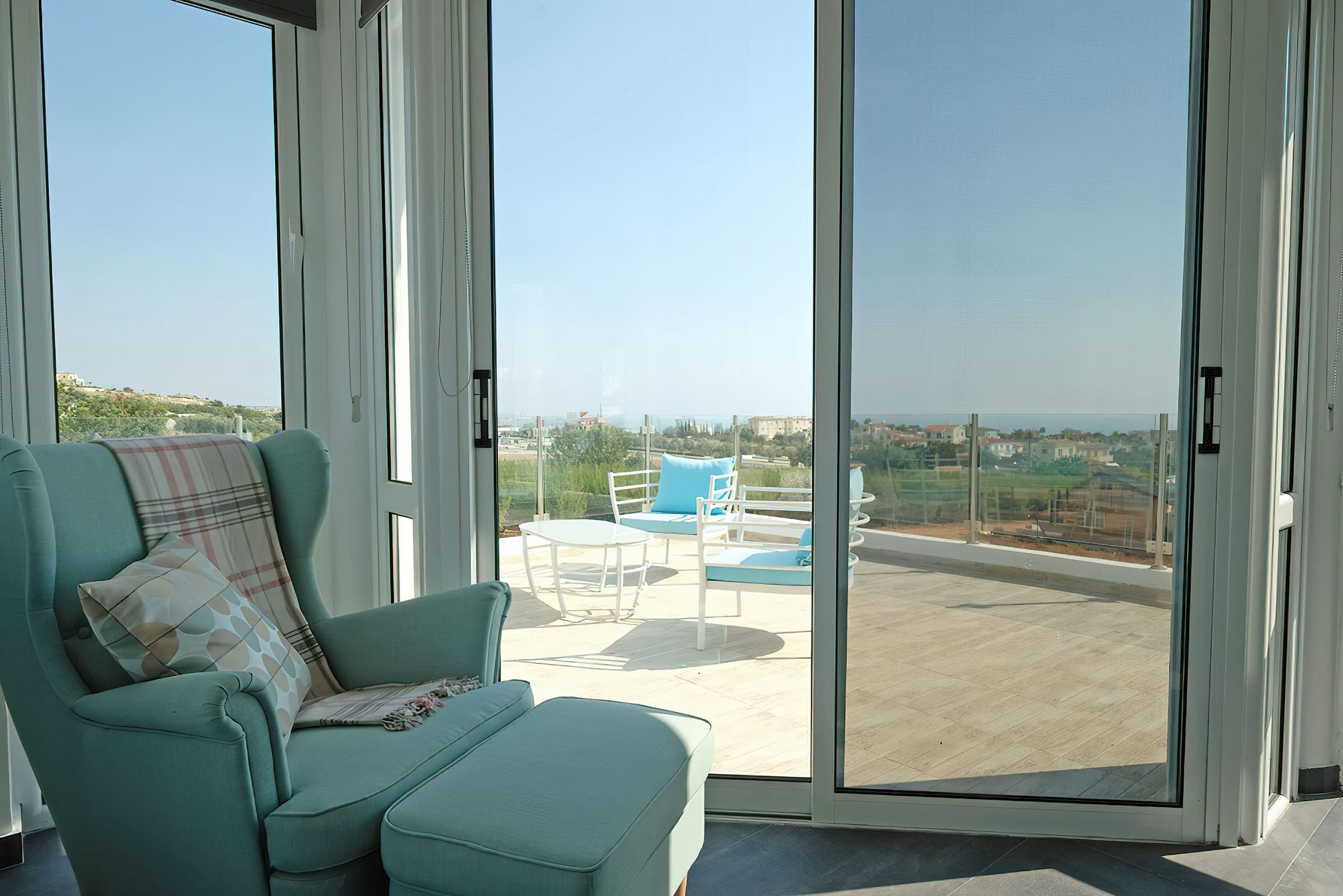
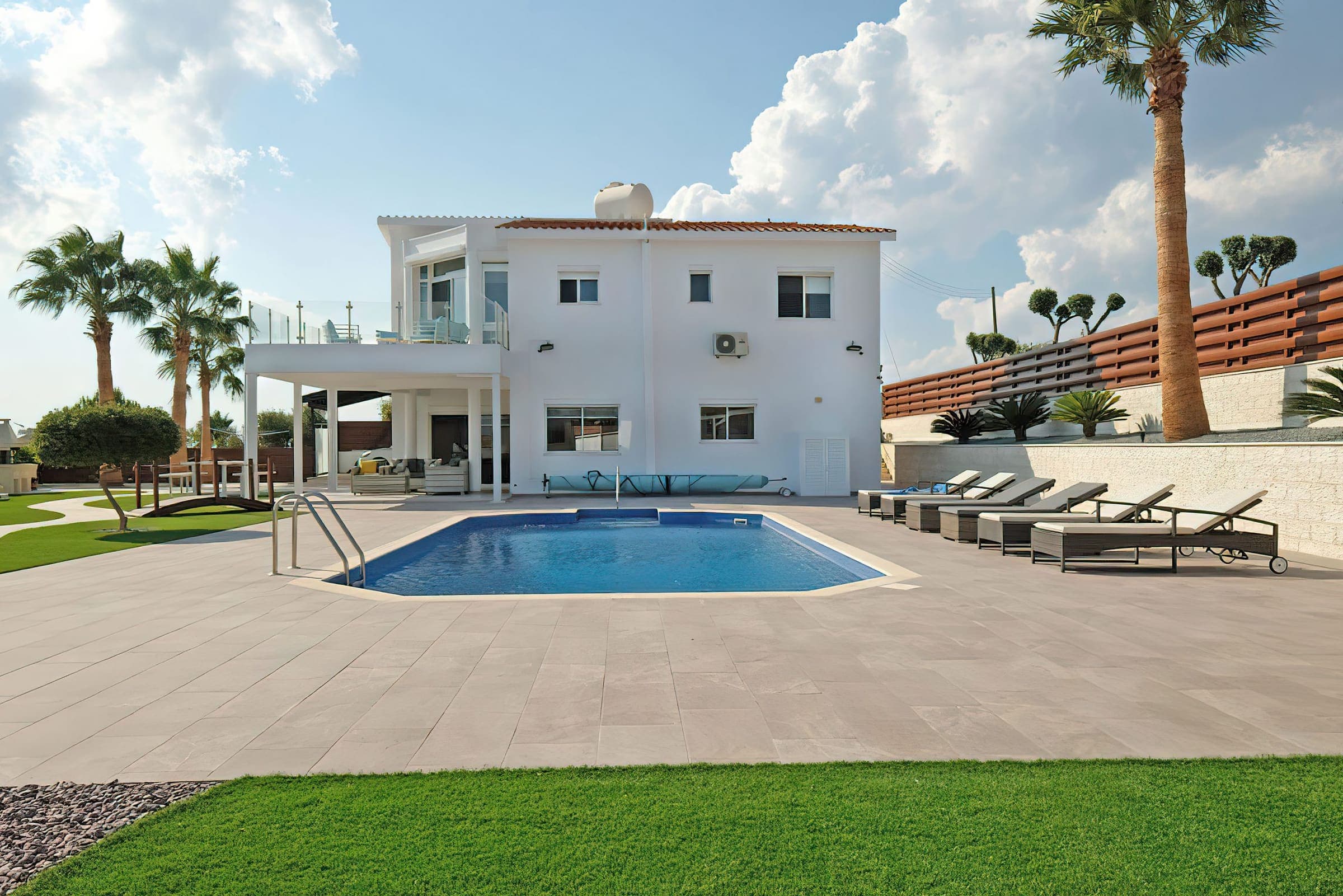
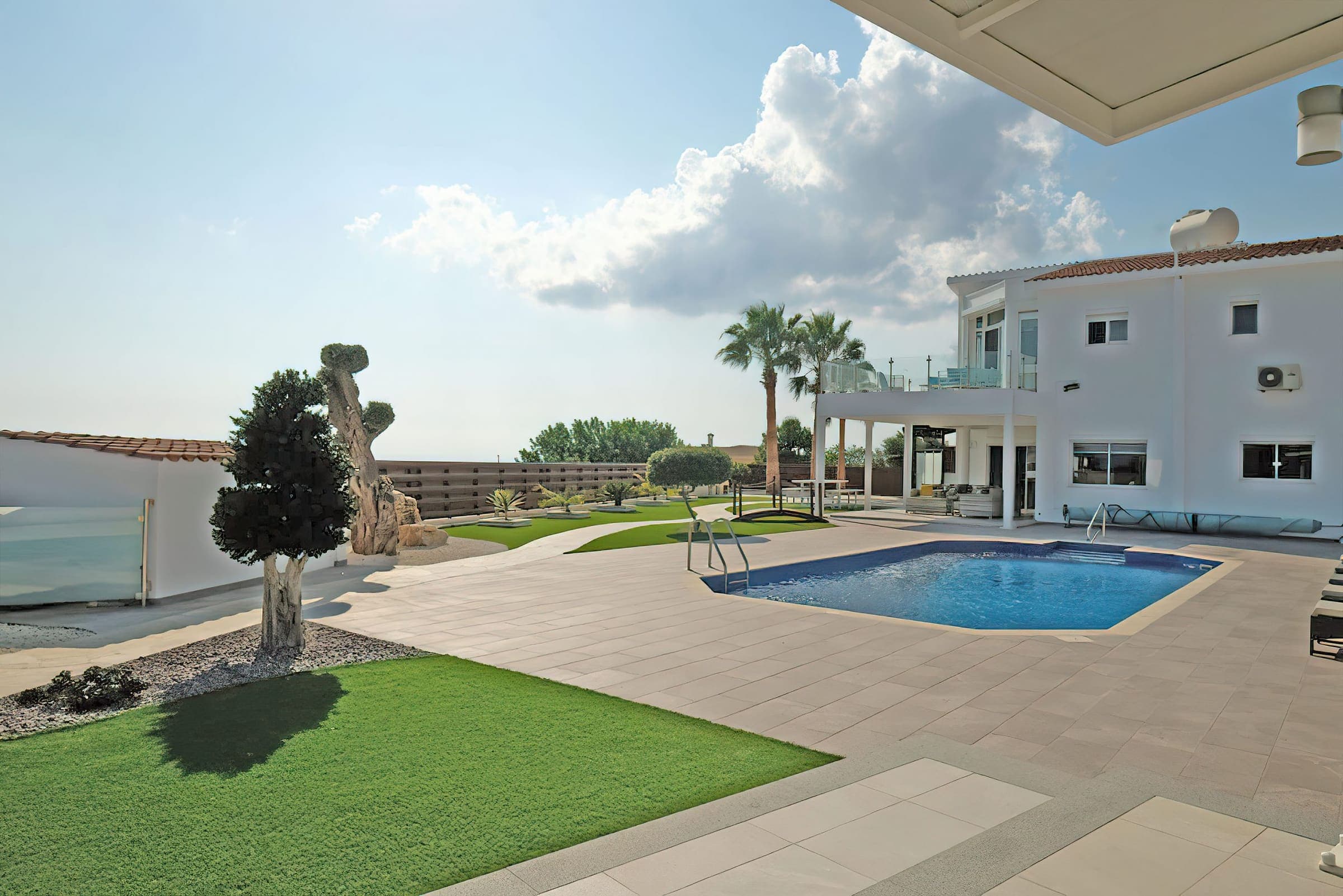
Villa Prasino is a private villa in Peyia for up to 6 guests, on the same stretch of coast as Agios Georgios. After a morning on the cape, there is a 6 × 12 m diving pool, a hot tub and an outdoor bar with fire pit seating, in 1,000 m² of gardens. See our villa by the Sea Caves, check availability and rates, or send us a booking request.